
Best Crawl Space Dehumidifiers (for dry, mold-free homes)
As an Amazon Associate, I earn from qualifying purchases. Some links may earn us a commission at no extra cost to you.
A crawlspace dehumidifier needs to remove meaningful amounts of moisture, fit into a low-clearance area, and drain continuously without demanding frequent attention. Capacity alone is not enough: dimensions, drainage method, airflow, filtration, low-temperature performance, and service access all matter. This guide focuses primarily on sealed or encapsulated crawlspaces. Before installing a dehumidifier, repair plumbing leaks, improve exterior drainage, and address standing water. A dehumidifier is designed to control airborne moisture, not compensate for an active water intrusion problem.
Top picks
1. Santa Fe Compact70 — Best for low-clearance crawlspaces
The Santa Fe Compact70 stands out because its cabinet is only approximately 12 inches tall, 12 inches wide, and 21 inches deep. That compact form makes it easier to position on a platform or suspend between joists where a conventional upright dehumidifier would not fit.
It removes 70 pints per day at 80°F and 60% relative humidity. It also includes a washable pre-filter and MERV-13 filtration, which is unusually robust for a compact crawlspace unit.
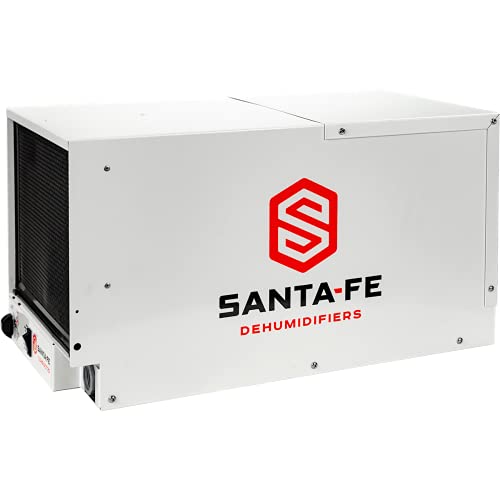
- Auto restart allows the dehumidifier to automatically restart after a power outage
- Unmatched 6-year warranty
- Engineered for low temperature operation and the air flow issues that crawl spaces present
Pros
- Rated for 70 pints per day at standard conditions
- Compact 12 × 12 × 21-inch cabinet
- MERV-13 filter and washable pre-filter
- Manufacturer lists an average sound level of 55 dBA
Cons
- Relies on gravity drainage
- Premium purchase price
Who should buy it: Homeowners who need dependable moisture removal in a short, tightly encapsulated crawlspace.
Scores: Performance 4.7/5 · Clearance 5/5 · Drainage 3.8/5 · Value 3.8/5
2. AprilAire E080W — Best smart crawlspace dehumidifier
The AprilAire E080W combines 80-pint daily moisture removal with Wi-Fi monitoring through the AprilAire Healthy Air app. Remote status updates, alerts, and humidity adjustments are valuable when the unit is installed in a crawlspace that is inconvenient to enter.
Its cabinet measures approximately 15 inches high, 14 inches wide, and 26 inches deep. It supports several ducted installation arrangements and includes a washable MERV-8 filter.
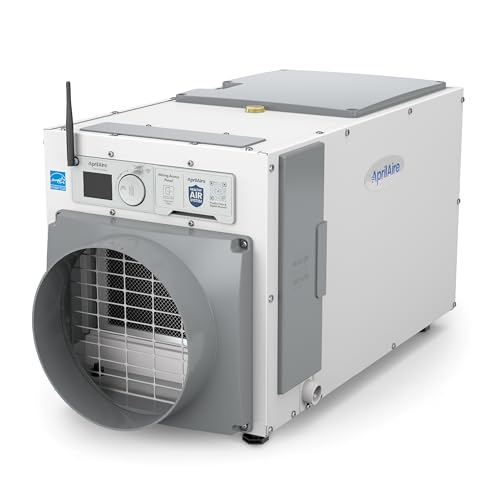
- IDEAL RELATIVE HUMIDITY – Achieve balanced humidity in your home which has been shown to reduce the incidence of problems and symptoms by minimizing the formation of irritants
- WI-FI INTEGRATED CONTROL – Control the AprilAire Dehumidifier by connecting it to your phone via the built-in Wi-Fi interface. Bluetooth is available for fast, simple pairing in three minutes or less. You will receive alerts, diagnostics, and updates on the unit directly to your phone.
- SIMPLE AND QUIET OPERATION – Simply set-it-and-forget-it. Dehumidification occurs until the RH set point is reached, then shuts off until periodic sampling determines a need for operation to resume. Top or end air discharge orientation is available and the 8-foot power cord allows for flexibility in placement.
Pros
- Removes up to 80 pints per day
- Wi-Fi monitoring and app-based controls
- Multiple ducting configurations
- Six-year warranty structure from the manufacturer
Cons
- No built-in condensate pump
- High purchase price
Who should buy it: Homeowners who want remote monitoring, documented installation options, and professional-grade humidity control.
Scores: Performance 4.6/5 · Smart controls 4.8/5 · Drainage 3.8/5 · Value 3.6/5
3. ALORAIR Sentinel HDi90 — Best built-in-pump crawlspace dehumidifier
The Sentinel HDi90 is the strongest choice when gravity drainage is not practical. Its integrated condensate pump can move collected water through a drain hose to a higher or more distant discharge point.
ALORAIR rates it at 90 pints per day under AHAM conditions and 198 pints under saturation conditions. Its approximately 15.2 × 23.2 × 17.7-inch cabinet remains reasonably compact for this capacity class.
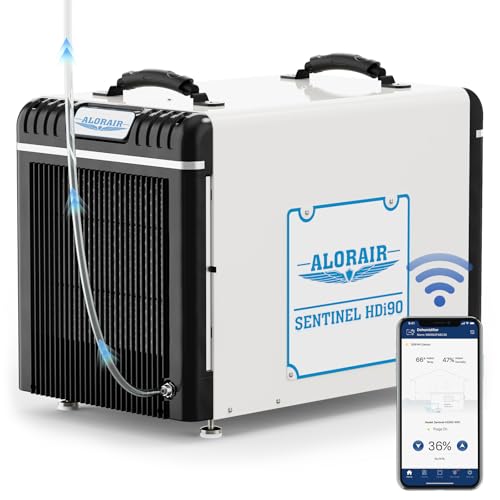
- Smart Remote Monitoring & Control - Seamlessly manage your AlorAir 198-pint crawl space dehumidifier with the free WiFi app. Monitor real-time humidity levels, adjust settings, and track progress from anywhere, ensuring consistent performance even when you're away. Enjoy hassle-free dehumidification with remote access
- High-Efficiency Dehumidifier - This commercial-grade 198-pint unit delivers efficient moisture removal (90 pints/day AHAM, 198 pints saturation). Designed for crawl spaces, basements and large areas up to 2600 sq ft, its continuous drainage system with included hose ensures hassle-free operation, it's an effective solution for crawlspace and commercial applications
- Advanced Dehumidifier for Modern Homes - Featuring C-ETL certified safety, this heavy-duty dehumidifier delivers high-efficiency moisture control for crawl spaces and basements. Its auto-defrost system maintains operation in low temperatures, while the MERV-1 filter improves air quality. With durable construction, it's an effective solution for both crawl space and commercial applications requiring reliable humidity management
Pros
- Rated for 90 pints per day at AHAM conditions
- Integrated condensate pump
- Automatic defrost and restart
- Supports ducting and optional remote control
Cons
- Pump adds another component that requires maintenance
- Taller than the lowest-profile models
Who should buy it: Homeowners whose drain route runs uphill, crosses a long distance, or cannot rely on gravity alone.
Scores: Performance 4.7/5 · Pump drainage 4.8/5 · Ease of use 4.5/5 · Value 4.3/5
4. ALORAIR Sentinel HD55 — Best value for smaller crawlspaces
The Sentinel HD55 is a more affordable option for smaller encapsulated spaces that do not require 70–90 pints of daily removal. It is rated for approximately 53 pints per day at AHAM conditions and up to 113 pints under saturation conditions.
Its metal housing, automatic defrost, memory restart, continuous gravity drainage, and compact horizontal design make it more appropriate for crawlspace use than a basic upright room dehumidifier.
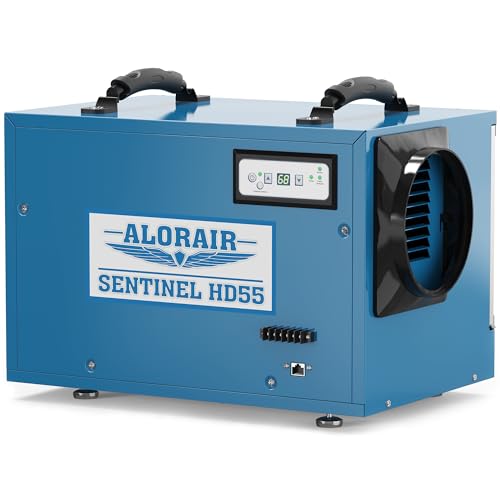
- 113 Pint Dehumidifier: AlorAir Sentinel HD55 commercial dehumidifier can remove 113 PPD at saturation, 53 pints per day at AHAM, up to 1,200 sq.ft, lowering the humidity to comfortable levels in a short period. On the other hand, this cETL-listed dehumidifier is made of a metal outer casing that withstands more rugged conditions, ensuring long-term use and easy maintenance. Fit any crawl spaces, basements, warehouses, offices, factories, shops, storage areas
- Super Convenient Usage: This high-quality dehumidifier is adjusted simply to the ideal humidity setting to minimize moisture and reduce odor. The MERV-1 Filter can protect internal components from dust when dehumidifying. The most convenient point is that you are not requested to pour away the water every hour like a typical domestic dehumidifier, there is no tank inside, it drains automatically
- Automatic Defrost: Our advanced auto-defrosting system continuously monitors the ambient temperature using built-in sensors. When the temperature is detected to be low, the unit initiates an automatic defrost cycle to prevent frost buildup and related issues. During this process, the compressor temporarily stops while the fan continues to operate, allowing the frost to thaw. Once the defrost cycle is complete, the dehumidifier resumes normal operation. This feature conserves energy and helps extend the lifespan of the unit
Pros
- Approximately 53-pint AHAM capacity
- Compact crawlspace-oriented cabinet
- Automatic defrost and restart
- Strong value for a commercial-style unit
Cons
- Gravity drainage only
- Too small for severe moisture loads or large crawlspaces
Who should buy it: Owners of smaller sealed crawlspaces with a nearby gravity drain and a moderate humidity problem.
Scores: Performance 3.9/5 · Clearance 4.4/5 · Ease of use 4.3/5 · Value 4.8/5
5. Moiswell Marshal WD160 — Best for fresh-air and ducted installations
The Moiswell Marshal WD160 is built more like a whole-home ventilation appliance than a basic standalone crawlspace unit. It includes a fresh-air intake, a convertible air outlet, 330 CFM airflow, two fan speeds, and a wired remote controller.
The manufacturer lists removal of up to 160 pints per day under high-humidity conditions and 65 pints per day under DOE conditions. Its fresh-air function makes it useful for planned ducted installations, but outside air should only be introduced as part of a properly designed humidity and ventilation strategy.
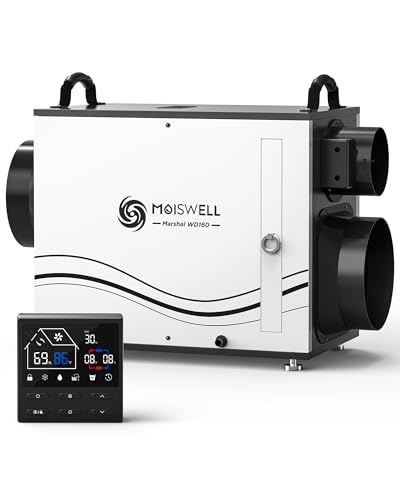
- 160 Pints/Day Upgraded Energy-Efficient Dehumidification: Built with an upgraded high-efficiency system, the Moiswell WD160 removes up to 160 pints of moisture per day (65 PPD @DOE) with lower energy consumption(2.25 L/wKh). It maintains optimal humidity levels across large living spaces, helping prevent structural damage such as wood rot and musty odors, while promoting a healthier indoor environment.
- Fresh Air Function for Healthier Indoor Living: Equipped with an advanced fresh air intake system, this whole-home dehumidifier not only removes excess moisture but also introduces fresh outdoor air by opening the fresh air damper. It helps improve indoor air quality, and create a cleaner, and more comfortable living environment.
- High Airflow for Fast, Whole-Home Coverage: Designed with powerful airflow performance of 330 CFM, this commercial dehumidifier delivers rapid and consistent air circulation for maximum moisture removal. Ideal for whole homes, basements, and crawl spaces, it ensures faster drying and more uniform humidity control throughout large areas.
Pros
- Fresh-air intake for designed ventilation systems
- Strong 330 CFM airflow
- Horizontal or vertical outlet configuration
- Remote controller and cycle timer
Cons
- Not as compact as dedicated low-clearance models
- Installation is more involved than a basic gravity-drain unit
Who should buy it: Homeowners planning a ducted crawlspace, basement, or whole-home installation that includes controlled fresh-air ventilation.
Scores: Performance 4.2/5 · Installation flexibility 4.7/5 · Ease of use 3.8/5 · Value 4.0/5
6. Abestorm Hurricane LGR85 — Best restoration-grade option
The Abestorm Hurricane LGR85 combines crawlspace-compatible dimensions with the rugged housing and pump drainage expected from a restoration machine. It removes 85 pints per day at AHAM conditions and up to 180 pints under saturation conditions.
Its integrated pump includes a long drain hose and can lift water when a floor drain is unavailable. The stackable housing and carrying handle also make it easier to relocate for storm cleanup, construction drying, or temporary basement use.

- High-Efficiency Dehumidification - Abestorm commercial dehumidifier with an airflow rate of 210 CFM, 350 CMH, can remove moisture 180 Pints day (under 80 ℉,60% RH) to create a comfortable environment. It's a great choice for spaces up to 16,100 Cubic Feet, such as basement, crawl space, warehouse, office, factory, store, or storage area.
- Built-in Pump & Gravity Drain- This commercial dehumidifier with pump automatically collects condensate and drains it safely with an excellent huge capacity of 85 PPD at AHAM, easy installation with 19.6 feet drainage hose without extension. This basement dehumidifier can drain water up to 14.7 feet.
- Intelligent Control & Easy to Use - Our commercial dehumidifier is equipped with a touch-sensitive smart screen for easier operation without worrying about the keys being damaged. This industrial dehumidifier can keep your place in the ideal 25%-80% humidity. It will automatically stop working when the specified humidity is reached.
Pros
- Rated for 85 pints per day at AHAM conditions
- Built-in condensate pump
- Rugged, compact, and stackable housing
- Automatic defrost, drainage, and restart
Cons
- Restoration design is less discreet than a permanent residential unit
- More machine than a mildly damp small crawlspace needs
Who should buy it: Homeowners, contractors, or property managers who need one machine for crawlspace control and occasional restoration or water-damage work.
Scores: Performance 4.6/5 · Durability 4.8/5 · Pump drainage 4.7/5 · Value 4.5/5
7. Waykar CPG130A — Best energy-efficient option with flexible drainage
The Waykar CPG130A combines a relatively low 14.17-inch cabinet height with both gravity and pumped drainage. It includes a 6.56-foot gravity hose and a 16.4-foot pump hose, giving installers more flexibility when the nearest suitable drain is not below the unit.
The listing advertises 130 pints per day at 95°F and 90% relative humidity. Its more comparable standard-condition capacity is approximately 70 pints per day. Airflow is listed at up to 206 CFM.
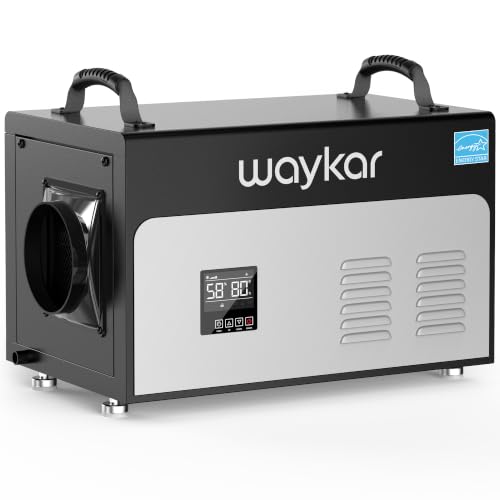
- 130 Pint Crawl Space Dehumidifier - Removes up to 130 pints of moisture per day (under 95°F, 90% RH) with a powerful high-brush motor and a maximum airflow of 206 CFM, effectively reducing humidity in spaces up to 7,500 square feet. The humidity is adjustable from 10% to 98% RH, offering greater control than most devices (which range from 20%-80% RH). Ideal for commercial, industrial, crawl spaces, storage rooms, garages, living spaces, and offices
- ENERGY STAR Certified - Waykar dehumidifier uses 45% less energy than non-certified models and 25% less than standard ENERGY STAR units. Running 24/7, it can cut annual electricity costs by up to $1,500, making it an eco-friendly, cost-saving choice for homes, basements, and businesses. Consider not just upfront cost but long-term savings—this energy-efficient model delivers better moisture control and greater lifetime savings
- Two Drainage Options and Pipe Installation - This commercial dehumidifier includes a 16.4-foot pump drainage hose, capable of draining vertically up to 16.4 feet—higher than the typical 10 to 13 feet in most models. It also features a 6.6-foot straight drainage hose for downward drainage. With pump-equipped dehumidifiers, you get more flexible installation options, including high-position, long-distance, and narrow space drainage. It also supports 5.9-inch pipe-mounted exhaust vents

Pros
- Approximately 70-pint capacity at standard conditions
- Built-in pump plus gravity-drain option
- Low 14.17-inch cabinet height
- Automatic defrost and power-loss memory
Cons
- Heavy at approximately 70 pounds
- Optional wired remote is sold separately
Who should buy it: Homeowners who want a low-profile machine with both pump and gravity drainage and who prioritize operating efficiency.
Scores: Performance 4.4/5 · Drainage flexibility 4.9/5 · Clearance 4.6/5 · Value 4.4/5
Quick comparison
- Santa Fe Compact70: Best for very low clearance and premium filtration.
- AprilAire E080W: Best for app monitoring and professional ducted installations.
- ALORAIR Sentinel HDi90: Best when a built-in pump is essential.
- ALORAIR Sentinel HD55: Best value for a smaller sealed crawlspace.
- Moiswell Marshal WD160: Best for fresh-air and whole-home ducting.
- Abestorm Hurricane LGR85: Best for restoration work and severe moisture.
- Waykar CPG130A: Best combination of low height, efficiency, and flexible drainage.
Buying guide
Compare standard-condition capacity
A headline capacity is only meaningful when you know the test conditions.
Some listings show moisture removal at approximately 95°F and 90% relative humidity. Those saturation-style figures can be dramatically higher than the amount removed in a normal crawlspace.
For a fair comparison, use AHAM or another standard-condition figure whenever possible:
- Around 50–55 pints per day: smaller sealed crawlspaces
- Around 65–80 pints per day: many medium crawlspaces
- Around 85–100 pints per day: larger spaces or heavier moisture loads
Square-foot coverage claims are less reliable because performance changes with temperature, air leakage, ceiling height, ground moisture, and the quality of the vapor barrier.
Plan the drain route before buying
Gravity drainage is the simplest arrangement. The hose must slope continuously downward to a suitable drain without dips that trap water.
Choose a built-in-pump model when the water must travel uphill, cross a long distance, or discharge into an elevated plumbing connection. Pumps add flexibility but also introduce another component that can clog or fail.
Measure clearance and service space
Measure the crawlspace opening, the route to the installation location, and the height available at the final position.
Do not use the cabinet dimensions alone. Leave enough room to:
- Remove and replace the filter
- Connect drain and duct hoses
- Reach the control panel
- Access service panels
- Maintain airflow around the inlet and outlet
A compact machine is not useful if the filter cannot be removed after installation.
Encapsulate before sizing the machine
A dehumidifier works most effectively in a sealed crawlspace with a properly installed ground vapor barrier and controlled exterior air leakage.
Open vents, exposed soil, standing water, foundation leaks, and disconnected downspouts can create a moisture load that overwhelms even a large dehumidifier.
Consider low-temperature operation
A cold evaporator coil can accumulate frost. Automatic defrost temporarily stops or changes compressor operation so the ice can melt.
This feature is important in crawlspaces that become cool during winter. Check the manufacturer’s minimum operating temperature, but remember that water-removal capacity normally decreases as temperature falls.
Decide whether you need ducting
Ducting can distribute dry air into separate crawlspace sections or allow the unit to serve a connected basement or whole-home system.
A simple open crawlspace may not require ducts. Complex foundations with isolated sections, additions, or mechanical rooms may benefit from planned supply and return paths.
Treat fresh-air ventilation carefully
A fresh-air intake is useful only when outdoor air conditions and the overall HVAC design are considered.
Introducing humid summer air can increase the moisture load. A ventilation-focused unit such as the Moiswell WD160 should be installed as part of a deliberate ventilation strategy rather than with its outdoor-air damper left open automatically.
Check filtration and replacement cost
A filter protects the coil from dust and debris. Higher-rated filters may also capture smaller particles, but they require regular maintenance to prevent restricted airflow.
Check the filter every few months at first. A dusty crawlspace may require more frequent cleaning or replacement.
Review warranty requirements
Warranty coverage may depend on:
- Purchase channel
- Installation method
- Product registration
- Maintenance records
- Manufacturing date
- Whether the unit was installed by a professional
Read the current warranty document for the exact model rather than relying only on a marketplace title.
Set a realistic humidity target
A common starting target for a sealed crawlspace is approximately 50–55% relative humidity. Setting the control much lower can increase energy use without providing a meaningful benefit.
Use a separate hygrometer in another part of the crawlspace to confirm that humidity is reasonably even throughout the area.
FAQs
What size crawlspace dehumidifier do I need?
A smaller sealed crawlspace with moderate moisture may be adequately served by a model around 50–55 pints per day at standard conditions.
Larger spaces, air leakage, damp soil, or persistent humidity may justify a unit in the 70–100-pint range. Correcting water intrusion and sealing the crawlspace can be more important than buying the highest-capacity machine.
Is the 130-pint Waykar more powerful than a 90-pint AHAM unit?
Not necessarily. The Waykar’s 130-pint figure is measured under hotter and more humid conditions. Its standard-condition capacity is approximately 70 pints per day.
A unit rated for 90 pints per day at AHAM conditions generally has greater comparable capacity.
What is the difference between AHAM and saturation ratings?
AHAM ratings traditionally represent performance near 80°F and 60% relative humidity. Saturation-style ratings are often measured near 90–95°F and 90% relative humidity.
A machine removes more water in hotter, wetter air, so saturation figures are substantially higher. Compare AHAM to AHAM or equivalent standard conditions.
Do I need a condensate pump?
A pump is necessary when the drain connection is higher than the dehumidifier or when gravity cannot create a reliable downward path.
Use gravity drainage when possible because it is mechanically simpler.
Can I place the dehumidifier directly on the ground?
It should sit on a stable, level platform that keeps it above possible standing water and supports its full operating weight.
Follow the manufacturer’s clearance requirements and do not block the inlet, outlet, filter, or service panels.
Can I hang a crawlspace dehumidifier between joists?
Some models can be suspended using an approved hanging kit or manufacturer-supported installation method.
The structure must safely support the unit, and vibration isolation may be needed. Do not improvise suspension hardware for a heavy machine.
Should crawlspace vents remain open?
A dehumidifier is generally most effective in a sealed or encapsulated crawlspace. Open vents can continuously introduce humid outdoor air.
Local building requirements vary, so consult a qualified contractor before permanently changing foundation ventilation.
What humidity should I use?
Start around 50–55% relative humidity and monitor conditions across the crawlspace.
A lower setting may make the machine run longer and consume more electricity. Persistent readings above the set point may indicate poor air circulation, excessive moisture entry, or an undersized unit.
Why does my dehumidifier run constantly?
Possible causes include:
- Active water intrusion
- Open crawlspace vents
- An incomplete vapor barrier
- A clogged filter
- Blocked airflow
- A poor drain setup
- A unit that is too small
- A humidity sensor located in an unusually damp area
Correct the moisture source before assuming the machine is defective.
How often should I clean the filter?
Inspect it every one to three months initially. Crawlspaces with dust, insulation debris, or construction activity may require more frequent maintenance.
Follow the manufacturer’s cleaning or replacement schedule.
Can a crawlspace dehumidifier prevent mold?
It can help maintain conditions that are less favorable for mold growth, but it cannot remove existing contamination or repair moisture-damaged materials.
Existing mold, rot, leaks, and wet insulation may require professional assessment and remediation.
Is the Abestorm LGR85 suitable for permanent installation?
It can maintain crawlspace humidity, but its rugged portable housing is designed partly for restoration and temporary drying.
A dedicated residential unit may integrate more neatly into a permanent ducted installation.
Is Wi-Fi worth paying for?
Wi-Fi is useful when the crawlspace is difficult to access. It can provide humidity readings, alerts, and status checks without requiring a physical inspection.
It does not replace periodic filter, hose, pump, and crawlspace inspections.
Final verdict
The Santa Fe Compact70 remains the best choice for a low-clearance crawlspace because it combines a 12-inch cabinet height, 70-pint standard-condition capacity, and MERV-13 filtration.
Choose the AprilAire E080W for app monitoring and professional ducting, or the ALORAIR Sentinel HDi90 when pumped drainage is essential. The ALORAIR Sentinel HD55 offers the best value for smaller spaces with a gravity drain.
The Moiswell Marshal WD160 is the most flexible option for planned fresh-air or whole-home ducting. The Abestorm Hurricane LGR85 is better for restoration work and severe moisture loads.
The Waykar CPG130A earns its place as the best balance of low cabinet height and drainage flexibility. Its built-in pump, gravity option, automatic defrost, and approximately 70-pint standard-condition capacity make it a practical choice for difficult crawlspace drain layouts.
As an Amazon Associate, I earn from qualifying purchases.