
Best Affordable 3D Metal Printers (Guide)
As an Amazon Associate I earn from qualifying purchases. Some links may earn us a commission at no extra cost to you.
When people look for an “affordable 3D metal printer,” what they usually end up with are FDM printers that can safely run metal-filled and carbon-fiber filaments, not industrial laser-powder machines that cost as much as a car. What really matters are nozzle temperature and hardness, enclosure (for ABS/ASA), speed/vibration control, and ease of use, so you’re not constantly fighting clogs and failed prints.
Top picks
1. Creality K1C — Best for fast, “metal-feel” engineering parts
Creality’s K1C is a CoreXY speed monster that’s designed for abrasive composites: it pairs a 300 °C hotend with a hardened steel-tipped nozzle and an all-metal extruder, and it’s explicitly positioned to handle carbon-fiber-filled filaments. You get fast printing, good rigidity, and an AI camera in one box.
No products found.
Pros
-
CoreXY frame stays stable at high speeds
-
300 °C hotend + hardened nozzle for abrasive filaments
-
Built-in AI camera for monitoring and time-lapses
-
Fully assembled and factory-calibrated, very quick to start
Cons
-
Enclosure is partial; ABS/ASA still finicky
-
Firmware and cloud features feel a bit ecosystem-locked
-
Not the quietest at full speed
Social proof
Independent reviews consistently highlight the K1C’s CoreXY rigidity, hardened steel-tip nozzle, and compatibility with carbon-fiber-filled filaments, along with solid dimensional accuracy even at aggressive speeds. See reviews on Amazon for real-world experiences.
Trade-offs / Who should skip
-
Great for you if you want fast, strong “engineering-ish” parts from CF or metal-filled PLA and don’t mind some tuning and fan noise.
-
Skip it if you need a fully enclosed, low-odor printer for ABS/ASA or you care more about whisper-quiet operation than raw speed.
Scores: Performance 4.7/5 · Abrasive-filament readiness 4.8/5 · Ease of Use 4.0/5 · Value 4.6/5
2. Flashforge AD5M — Best CoreXY workhorse for metal-filled & CF filaments
The Flashforge AD5M takes the Adventurer platform and stretches it into a full CoreXY, all-metal motion system with headline speeds up to 600 mm/s and a quick-swap nozzle system. Official materials list PLA-CF and PETG-CF among its supported filaments when paired with the appropriate nozzle and build plate.

- Flashforge Adventurer 5M Pro 3D Printer
Pros
-
All-metal CoreXY structure handles high-speed printing
-
Quick-swap nozzle system encourages hardened-nozzle use
-
Supports PLA-CF, PETG-CF with appropriate plate/nozzle
-
Strong ecosystem of plates, nozzles, and enclosures
Cons
-
Open frame; enclosure is an extra add-on
-
Advanced features can overwhelm absolute beginners
-
Larger, heavier footprint than basic bedslingers
Social proof
Flashforge’s documentation plus editorial reviews highlight the AD5M’s CoreXY mechanics, 600 mm/s speeds, quick-swap nozzles, and CF-compatible build surfaces, with user feedback often praising reliability once it’s dialed in. See reviews on Amazon for up-to-date impressions.
Trade-offs / Who should skip
-
Great for you if you want a shop-ready, mod-friendly CoreXY that can grow with hardened nozzles, AD5M-specific plates, and an optional enclosure.
-
Skip it if you need a compact, super-quiet classroom printer or you don’t want to think about nozzle choices for different filaments.
Scores: Performance 4.6/5 · Abrasive-filament readiness 4.7/5 · Ease of Use 3.9/5 · Value 4.5/5
3. Flashforge Adventurer 5M — Best beginner-friendly step into metal-filled filaments
Adventurer 5M is the “easy mode” sibling to AD5M: same 600 mm/s-class CoreXY platform, but tuned to be plug-and-play. With the 0.6 mm nozzle and appropriate build plate, it supports PLA-CF and PETG-CF in addition to standard PLA/PETG/TPU.

- 【Succeed with a Perfect First Layer】Full-auto one-click leveling calibrates and levels the bed properly, making you a perfect first layer for every 3D print. It provides accurate and smooth surface to achieve quality printing performance.
- 【Ultra-Fast and Exceptional Quality】Core XY up to 20000 mm/s² Acceleration, Maximum speed 600mm/s, the acceleration from zero to 600 mm/s takes just 0.025 seconds. From unboxing to starting printing, Only 10mins, Enjoy happy printing every day and great all-around quality.
- 【Vibration Compensation&Less Waiting Time】Vibration compensation, eliminating ghosting in prints. Nozzle with a flow of 32mm³/s, 50w heating power, 200℃ heating up in 35 seconds. Precise and consistent extrusion for smooth and no-blur prints.
Pros
-
Very beginner-friendly setup and auto-leveling
-
280 °C direct-drive nozzle supports CF composites (0.6 mm)
-
Flashforge ecosystem: plates, nozzles, optional enclosure kit
-
Good balance of speed, quality, and noise for home use
Cons
-
Stock 0.4 mm nozzle not ideal for abrasive filaments
-
Open front; optional enclosure adds cost and bulk
-
Build volume smaller than AD5M or K1C
Social proof
The Adventurer 5M is widely described as an easy “first CoreXY” with fast setup and decent acoustics, and the manufacturer explicitly documents filament support that includes carbon-fiber-reinforced materials when paired with the right nozzle and plate. See reviews on Amazon for long-term user experience.
Trade-offs / Who should skip
-
Great for you if you want one printer that starts as a friendly PLA machine and can later move into CF/metal-filled PLA with minor upgrades.
-
Skip it if you already know you want fully enclosed printing, bigger volume, or hardcore tinkering—AD5M or Centauri Carbon will fit better.
Scores: Performance 4.3/5 · Abrasive-filament readiness 4.3/5 · Ease of Use 4.8/5 · Value 4.5/5
5. ELEGOO Neptune 4 Pro — Best budget base for upgrading to metal-filled
Neptune 4 Pro is a fast Klipper-based bedslinger with a 225 × 225 × 265 mm build volume, 300 °C high-temp nozzle, dual-gear direct extruder, and up to 500 mm/s claimed speeds. Out of the box it’s great for standard PLA/PETG/ABS/ASA; with a hardened steel nozzle kit marketed for Neptune 4/4 Pro, it becomes a solid platform for abrasive filaments (including carbon-fiber and metal-filled filaments).
Why it wins: It’s probably the cheapest way into a metal-capable setup: buy the printer, then add a hardened nozzle kit once you’re ready to run abrasive materials.
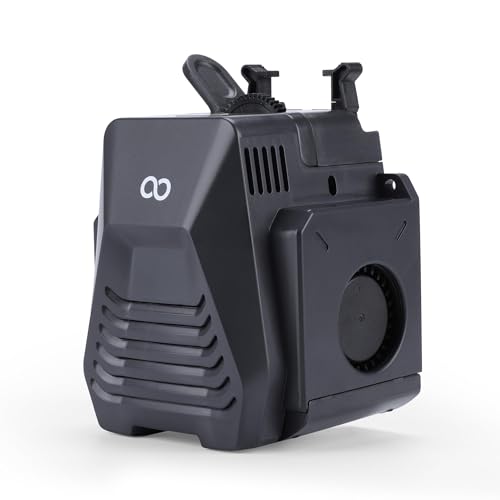
- Fully assembled extruder for Neptune 4 Pro ONLY, NOT for Neptune 4/4 Plus/4 Max
- All extruders are tested before shipping, so some test filament may remain inside
- ELEGOO Official 3D Printer Accessories

Pros
-
Klipper firmware and fast motion control
-
300 °C nozzle and segmented heatbed for tougher plastics
-
Direct-drive extruder handles flexible filaments nicely
-
Hardened-nozzle kits rated for metal-filled filaments
Cons
-
Open frame; drafts can affect ABS/ASA and CF parts
-
Tuning Klipper features can intimidate beginners
-
Needs upgraded nozzle before serious abrasive use
Social proof
Elegoo focuses on the Neptune 4 Pro’s speedy Klipper stack and 300 °C nozzle, while third-party hardened-nozzle kits for the Neptune 4/Pro are marketed for carbon-fiber and metal-filled filaments. The community clearly treats this as an upgradeable composite-ready machine. See reviews on Amazon for user-reported reliability.
Trade-offs / Who should skip
-
Great for you if you’re a budget-conscious tinkerer happy to install hardened nozzles and tweak profiles for metal-filled/CF filaments.
-
Skip it if you want an enclosed, lower-tinker machine or you don’t care about Klipper features.
Scores: Performance 4.4/5 · Abrasive-filament readiness 4.0/5 · Ease of Use 3.8/5 · Value 4.7/5
Quick compare
-
Creality K1C — Best for speed + strength: CoreXY, 300 °C hotend, hardened nozzle, built-in camera; louder and more “tuner-friendly” than truly beginner printers.
-
Flashforge AD5M — Best CoreXY workhorse: Open, rigid, 600 mm/s-class with quick-swap nozzles and CF support; wants an add-on enclosure and a user who doesn’t mind tinkering a bit.
-
Flashforge Adventurer 5M — Best beginner path into composites: Plug-and-play CoreXY that later grows into CF/metal-filled printing with a 0.6 mm nozzle and the right plate; open front and modest volume.
-
ELEGOO Neptune 4 Pro — Best budget upgrade platform: Fast Klipper bedslinger with 300 °C nozzle; needs a hardened nozzle kit and some tuning before you push abrasive filaments hard.
FAQs
Q: Are these “real metal 3D printers”?
A: Not in the industrial sense. These are FDM printers that melt plastic filaments—some of which contain fine metal powder or carbon fiber. They’re great for metal-looking parts, stiffer brackets, or cosplay props, but they don’t produce the fully metallic, heat-treatable parts that powder-bed laser systems do.
Q: What do I actually need to print metal-filled or carbon-fiber filaments?
A: You want:
-
A printer with a high-temp hotend (around 280–300 °C)
-
A hardened steel or steel-tipped nozzle, ideally 0.6 mm or larger
-
Sensible cooling and speeds—you usually run these slower than plain PLA until you’re dialed in
Q: Do I need special safety gear for metal-filled printing?
A: You should treat any 3D printing as something that benefits from good ventilation, especially with ABS/ASA or exotic composites. For metal-filled and CF filaments, avoid sanding without a mask, and consider using a small particulate mask and local extraction if you’re doing a lot of finishing work. Always follow each filament maker’s safety guidance.
Q: Which single printer would you choose if you want metal-looking parts but also easy day-to-day use?
A: If I had to pick one for most people right now, it would be Creality K1C for its mix of speed, hardened nozzle, and CoreXY rigidity, or Centauri Carbon if you really want an enclosure and a more “semi-pro” workflow at home.
As an Amazon Associate, I earn from qualifying purchases.